AI Automation for Small Business: Examples, ROI, and a Simple Framework
AI automation is not about replacing people. It is about removing the repetitive work that quietly eats a small business owner's week.
Small business owners rarely lack work — they lack time. The same tasks repeat every week: answering the same questions, following up on leads, booking appointments, writing posts. AI automation handles the repetitive layer so you can spend your hours on the work that actually grows the business.
This guide covers real examples, a simple ROI calculation, and a framework you can apply without a technical background.
Quick answer
AI automation for small business uses AI-assisted tools to handle repetitive tasks like FAQ replies, lead follow-up, reminders, and content drafts. Start with high-frequency tasks, calculate ROI from time saved, and keep a human in the loop.
What AI Automation Actually Means
AI automation combines two ideas: automation (a task runs without you starting it each time) and AI (the system can understand language and draft responses). Together they let a small business auto-reply to a common question, summarize a call, or draft a follow-up email — then route it to a person when judgment is needed.
The point is not to remove people. It is to remove the drudgery so your team spends time on relationships and decisions. For a deeper look at the people side, see the AI employee guide.
Real Examples by Business Function
- Intake: acknowledge new inquiries instantly and collect the details you need before a call.
- Follow-up: send a helpful reminder or next step when a lead goes quiet.
- Support: answer common FAQ messages with accurate, on-brand replies.
- Operations: summarize meeting notes and turn them into action items.
- Marketing: draft social posts and email newsletters for human review.
- Sales: route qualified leads to the right person with context attached.
How to Calculate ROI
Use a simple model:
- Estimate hours saved per week (e.g., 6 hours).
- Multiply by your effective hourly value (e.g., $40) = $240/week.
- Annualize: $240 × 52 = $12,480.
- Subtract tool and setup cost (e.g., $1,200/year).
- ROI = ($12,480 − $1,200) ÷ $1,200 = 940%.
Add fewer missed leads as upside, but only count what you can defend. The CRM and AI Automation Guide expands this with a calculator model.
A Simple 5-Step Framework
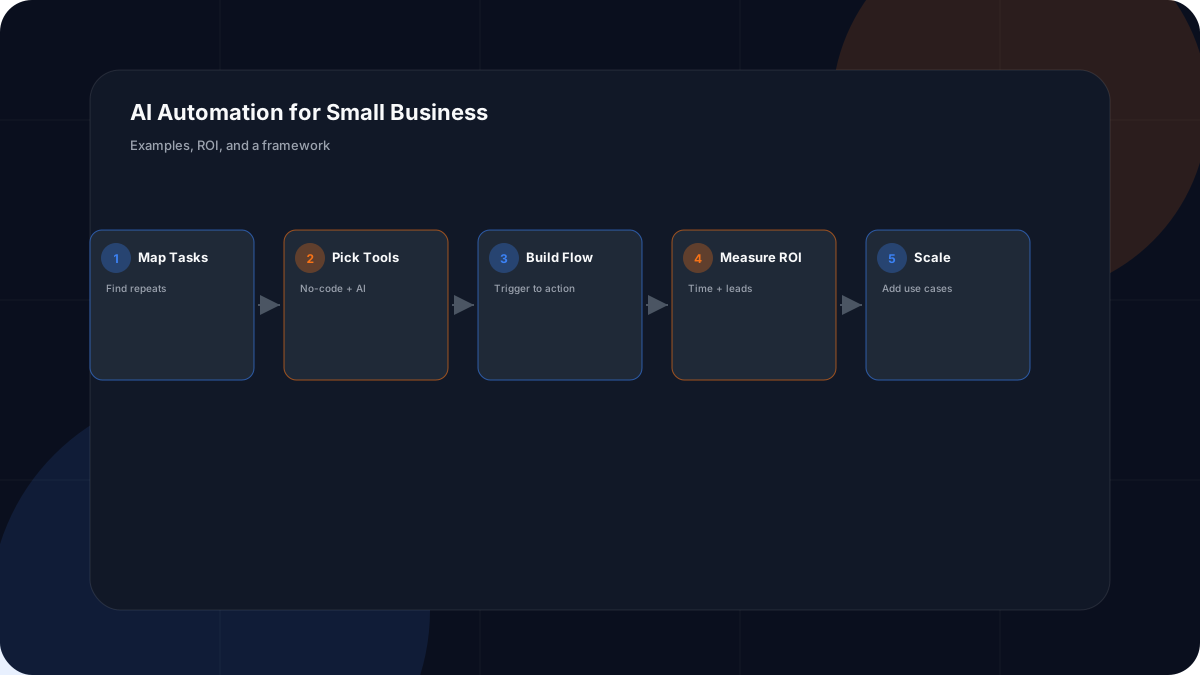
1. Map tasks. List what you repeat weekly. 2. Pick tools. Choose no-code tools or an AI employee. 3. Build the workflow. Connect trigger to action. 4. Measure ROI. Track time and leads saved. 5. Scale. Add the next use case once the first works.
If you would rather not build it yourself, Wade Digital builds AI automation in Calgary.
Automation Readiness Checklist
Frequently Asked Questions
What is AI automation for small business?
AI automation for small business means using AI-assisted tools to handle repetitive, rules-based work such as answering common questions, drafting follow-up messages, summarizing notes, and routing leads. The goal is to free the owner and team for higher-value work, not to replace human judgment.
What are examples of AI automation?
Common examples: auto-replying to FAQ messages, drafting and scheduling social posts, summarizing meeting notes, routing new leads to the right person, sending appointment reminders, and generating first-draft proposals. The best examples save time on tasks you already do by hand.
Is AI automation worth it for a small business?
It is worth it when the task is frequent, repetitive, and well-defined. If automation saves even five hours a week at a value of $40/hour, that is $200/week or about $10,000/year. Most small businesses find value in intake, follow-up, and content drafting first.
How do I calculate AI automation ROI?
Estimate hours saved per week, multiply by your effective hourly value, then subtract the tool and setup cost. ROI = (annual value of time saved minus cost) divided by cost. Include fewer missed leads and faster response as upside, but do not count revenue you cannot support with evidence.
What tasks should a small business automate first?
Start where repetition and delay cost you most: lead follow-up, appointment reminders, FAQ replies, meeting summaries, and first-draft content. These are low-risk, high-frequency, and easy to measure.
Do I need technical skills to use AI automation?
No. Most modern tools are no-code or low-code with templates. You need to describe the task clearly and review the output. For deeper integrations, a specialist can connect your CRM and email, but many businesses start with off-the-shelf tools.
Will AI automation replace my staff?
Used well, it supports staff by removing drudgery, not replacing judgment. It handles routine steps so people focus on relationships, decisions, and skilled work. Be transparent with customers when AI is involved.
What are the risks of AI automation?
Main risks are inaccurate output, data privacy, and a robotic customer experience. Mitigate with human review, clear boundaries on what AI can do, and secure handling of customer information.
How much does AI automation cost?
Entry-level tools can be free or under $50/month. Integrated workflows and an AI employee typically cost more depending on complexity. Calculate ROI before buying; the cheapest tool that solves the task is usually best.
Can AI automation integrate with my CRM?
Yes, most automation platforms connect to popular CRMs through native integrations or APIs. That is how lead routing, reminders, and notes get written back to the record automatically.
What is the difference between AI automation and RPA?
Robotic Process Automation mimics clicks in software to move data between systems. AI automation adds language understanding and drafting. They are often combined: RPA moves the data, AI decides what to say.
Get the Free Master Lead Generator Website Blueprint
This article shows where AI automation fits. The free Blueprint PDF maps the full local lead-generation system — website, follow-up, and review flow — so automation has something strong to plug into. Download it to design your system.
Related Resources
Conclusion
AI automation pays off when it targets frequent, well-defined tasks and keeps a human in the loop. Start small, measure the time and leads you recover, and expand only what proves its ROI. Pair it with a strong website and follow-up system and the whole lead engine gets faster.
Download the free Master Lead Generator Website Blueprint PDF to see how automation fits the larger local lead-generation system.