Lead Generation System: A Repeatable Framework for Local Businesses
Random leads come from luck. A system produces them. Here is the five-part framework local businesses can actually run.
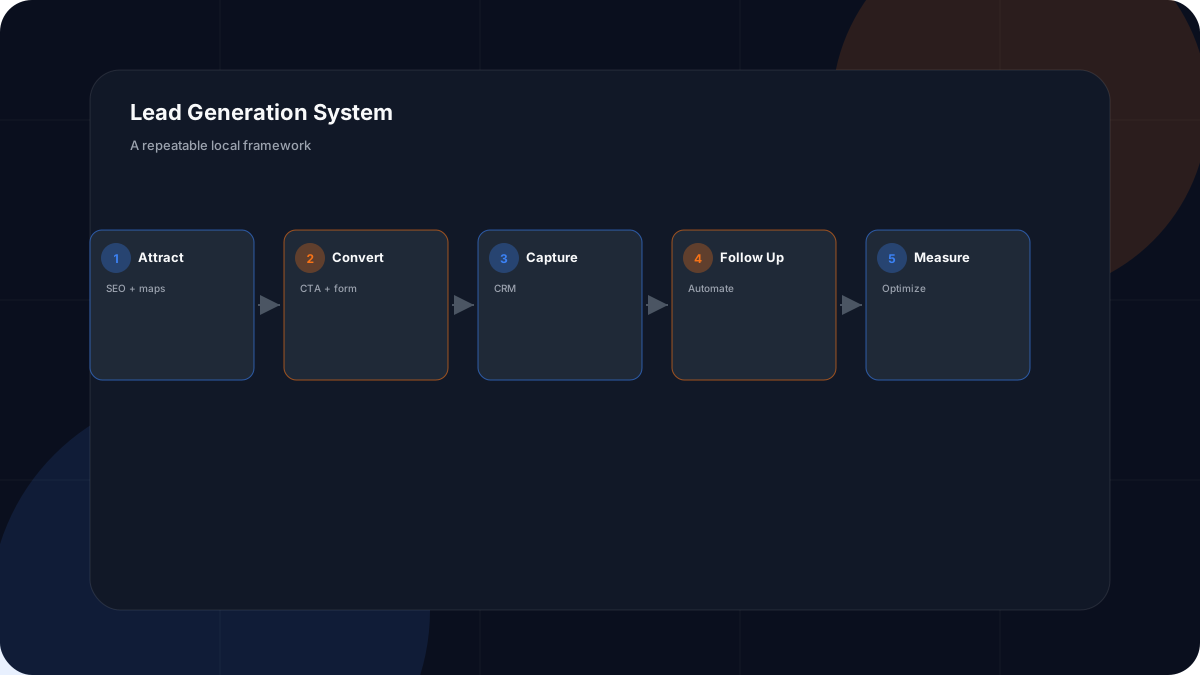
Most businesses do not have a lead problem — they have a system problem. They rely on referrals and hope. A lead generation system makes demand predictable by connecting the pieces: traffic, conversion, capture, follow-up, and measurement.
Quick answer
A lead generation system has five parts: attract the right visitors, convert them with a clear CTA, capture details into a CRM, follow up automatically, and measure results. Build each and connect them; improve the weakest link.
The Five Parts
- Attract: local SEO, Google Maps, referrals, content.
- Convert: clear offer, strong CTA, fast mobile site.
- Capture: short form feeding the CRM.
- Follow up: automated, consistent sequence.
- Measure: lead source, response time, ROI.
The Lead Generation Website Builder is purpose-built for the convert and capture stages.
Trade-Specific Examples
Contractors: maps visibility + quote form + fast follow-up. Electricians: emergency CTA + reviews + after-hours capture. Roofers: local pages + photos + financing language. The mechanics are the same; only the intent and proof differ.
Measure and Improve
Track lead volume by source, response time, lead-to-customer rate, and cost per lead. Improve the weakest link — often follow-up or the offer — before buying more traffic. A small conversion gain compounds across every channel.
Lead Generation System Checklist
Frequently Asked Questions
What is a lead generation system?
A lead generation system is the connected set of activities that consistently turns strangers into qualified leads: attracting the right visitors, converting them on-site, capturing their details, following up, and measuring what works. It is a system, not a one-off tactic.
How do I build a lead generation system?
Map the flow from first touch to booked job: traffic source, landing page, CTA, form, CRM, follow-up, and review. Build each piece, connect them, and measure. The <Link href='/resources/local-lead-generation-guide' className='text-blue-600 underline'>Local Lead Generation Guide</Link> walks through it.
What are the parts of a lead generation system?
Five parts: attract (SEO, maps, referrals), convert (clear offer and CTA), capture (form and CRM), follow up (automated sequence), and measure (analytics and ROI). Each must work for the system to work.
How do I generate leads for my contracting business?
Optimize your Google Business Profile, build service and city pages, collect reviews, and make the quote request obvious. Then follow up fast. Contractors win on local visibility and response speed.
How do electricians generate leads?
Electricians benefit from emergency and upgrade intent: local SEO for 'electrician near me', clear emergency CTA, reviews, and fast follow-up. A simple, fast mobile site converts after-hours searches.
How do roofers generate leads?
Roofers win with storm and replacement intent: Google Maps visibility, before/after photos, financing or insurance language, and a quote form. Reviews and local pages reinforce trust.
What is the difference between a lead and a sale?
A lead is a potential customer who has shown interest (form, call, quote request). A sale is the closed job. The system's job is to produce qualified leads the sales process can convert.
How do I measure a lead generation system?
Track lead volume by source, response time, lead-to-customer rate, and cost per lead. Improve the weakest link rather than chasing more traffic.
Do I need a website for lead generation?
Strongly recommended. A website is the conversion hub that captures intent from maps and search. Social alone cannot reliably capture and route leads the way a site plus CRM can.
What is the cheapest lead generation method?
Often the highest-return low-cost method is fixing your existing conversion: clearer CTA, faster mobile site, better follow-up. That improves every channel you already have.
How long does it take to build a lead generation system?
Foundations (site, profile, CRM) can be live in weeks; compounding visibility takes months. Start with the pieces that capture and follow up, then expand traffic.
Get the Free Master Lead Generator Website Blueprint
This article outlines the system. The free Blueprint PDF gives the exact website structure, follow-up flow, and review loop that makes it run — download it and build your lead engine.
Related Resources
Conclusion
A lead generation system beats hoping for referrals. Build the five parts, connect them, and measure. Start with conversion and follow-up — they improve every channel you already have. Download the free Blueprint PDF to get the structure.